

Calendar Days vs Business Days: What Should You Count?
Somebody tells you "five business days," or a form says "ten calendar days," and suddenly you need to know something the wording itself doesn't fully spell out: does Saturday count? What about a public holiday that happens to fall in the middle of that window? Get the day type wrong, and the date you land on can be off by several days without you realising it.
The two terms sound like they might be interchangeable. They're not, and the difference actually matters.
Quick Answer: Calendar Days or Business Days?
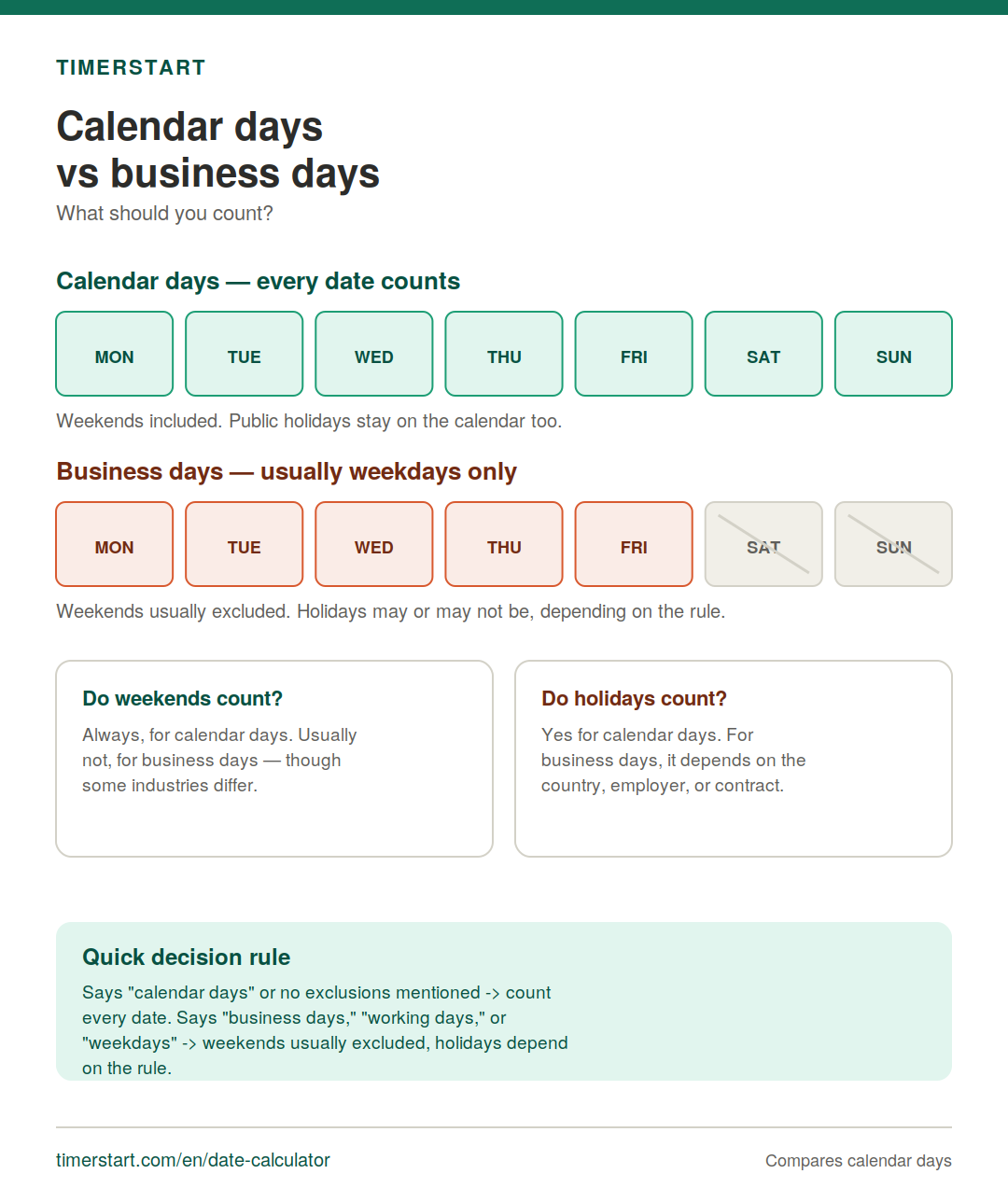
If the instruction says "calendar days," or doesn't mention any exclusions at all, count every date on the calendar - weekends included. If it says "business days," "working days," or "weekdays," weekends are usually left out, and holidays might be too, depending on whose rule you're following.
Calendar days: every date on the calendar, weekends included. Business days: usually weekdays, with weekends excluded and holidays handled according to whatever rule actually applies.
Use TimerStart's Date Calculator when you need to compare calendar days between two dates.
What Counts as a Calendar Day?
A calendar day is just any date on the calendar - Monday through Sunday, Saturdays and Sundays included, public holidays included too, since a holiday doesn't stop being a date. A calendar-day count moves through every single day in sequence with nothing skipped.
Take a five-calendar-day period starting on a Friday: it runs straight through Saturday and Sunday without pausing, same as any other pair of days.
This is what TimerStart's Date Calculator works with - it compares local calendar days, nothing gets automatically excluded.
What Counts as a Business Day?
Business days commonly mean Monday through Friday, with Saturday and Sunday usually left out. Public holidays are often excluded too, but this genuinely depends on the country, the organisation, the bank, the court, the employer, or whatever contract is involved - there's no single rule that covers every situation. Some workplaces even run on schedules that don't map neatly onto a standard five-day week.
Here's the thing worth remembering: not every weekday is automatically a business day, and the official definition that applies to your specific situation always takes priority over a general one.
Five standard business days starting on a Friday would typically land on the following Friday, once the weekend in between gets skipped - but a public holiday falling inside that stretch can push the result further out.
Calendar Days vs Business Days at a Glance
| Feature | Calendar days | Business days |
|---|---|---|
| Monday to Friday | Included | Usually included |
| Saturday and Sunday | Included | Usually excluded |
| Public holidays | Included as calendar dates | May be excluded, depending on the rule |
| Definition | Standard calendar sequence | Depends on the applicable rule |
| Typical use | Trips, elapsed time, general date ranges | Shipping, banking, workplace, or administrative periods |
| TimerStart support | Yes | Not currently a verified business-day calculator |
Treat this as a general pattern rather than a fixed rule - the specific policy or instruction you're following always wins.
Start With the Exact Wording
"Calendar days" or "consecutive days" normally means every date, weekends included. "Business days," "working days," or "weekdays" normally means weekends are excluded. Specialist terms - banking days, court days, trading days - often carry their own specific definitions that don't map directly onto either of the above.
If the wording just says "days" with nothing else to go on, that's a signal to check the source rather than assume. A calculator can't read intent into a document - it can only apply whichever rule you tell it to apply, so figuring out the right rule is a step that has to happen first.
Do Weekends Count?
Weekends count as calendar days - always, since they're dates like any other. They're usually excluded from business-day counts, though some industries treat weekends as ordinary working days, so "usually" is doing real work in that sentence.
Five calendar days from a Friday reaches the following Wednesday. Five standard Monday-to-Friday business days from that same Friday normally reaches the Friday after - a full four days apart, purely because one count skips the weekend and the other doesn't.
Do Public Holidays Count?
In a calendar-day calculation, yes - a public holiday is still a date, so it stays included the same as any other day.
In a business-day calculation, it depends. Holidays may be excluded, but whether that happens - and which holidays even apply - comes down to the country, region, employer, bank, government agency, court, contract, or industry involved. There's no universal answer here, and this article isn't going to pretend there is one. The honest advice is to check the official calendar or policy that's actually relevant to your specific deadline.
Do You Count the Start Date or the End Date?
This is a genuinely separate question from calendar versus business days, and mixing the two up is an easy mistake. Day type decides which dates are eligible to count at all. Inclusive or exclusive counting decides whether the first or last date in your range gets counted.
A standard date-difference calculation often doesn't count the starting date, though some official processes use their own convention, and some deliberately include the final date. TimerStart's Date Calculator currently lets you choose whether to include the end date - but picking that option doesn't resolve a specialised legal or contractual counting rule if one applies to your situation.
When Should You Count Calendar Days?
Calendar days tend to fit situations like measuring how long a trip lasts, comparing general date ranges, tracking elapsed time, planning an event, checking a reservation length, or following any instruction that explicitly says "calendar days."
A practical version: a trip runs from June 1 to June 10. A calendar-day calculation shows the gap between those dates directly, and you can choose whether to include the final day depending on what you're actually trying to measure.
When Should You Count Business Days?
Business days often come up around shipping and delivery estimates, banking processing times, workplace response periods, customer-support timelines, administrative processing, contractual notice periods, or court filing deadlines.
These are common examples, not universal rules - a shipping company, a bank, an employer, or a government office can each define "business day" a little differently. Because of that, TimerStart shouldn't be treated as a business-day calculator; it currently works with calendar days only.
How to Use TimerStart for Calendar-Day Calculations
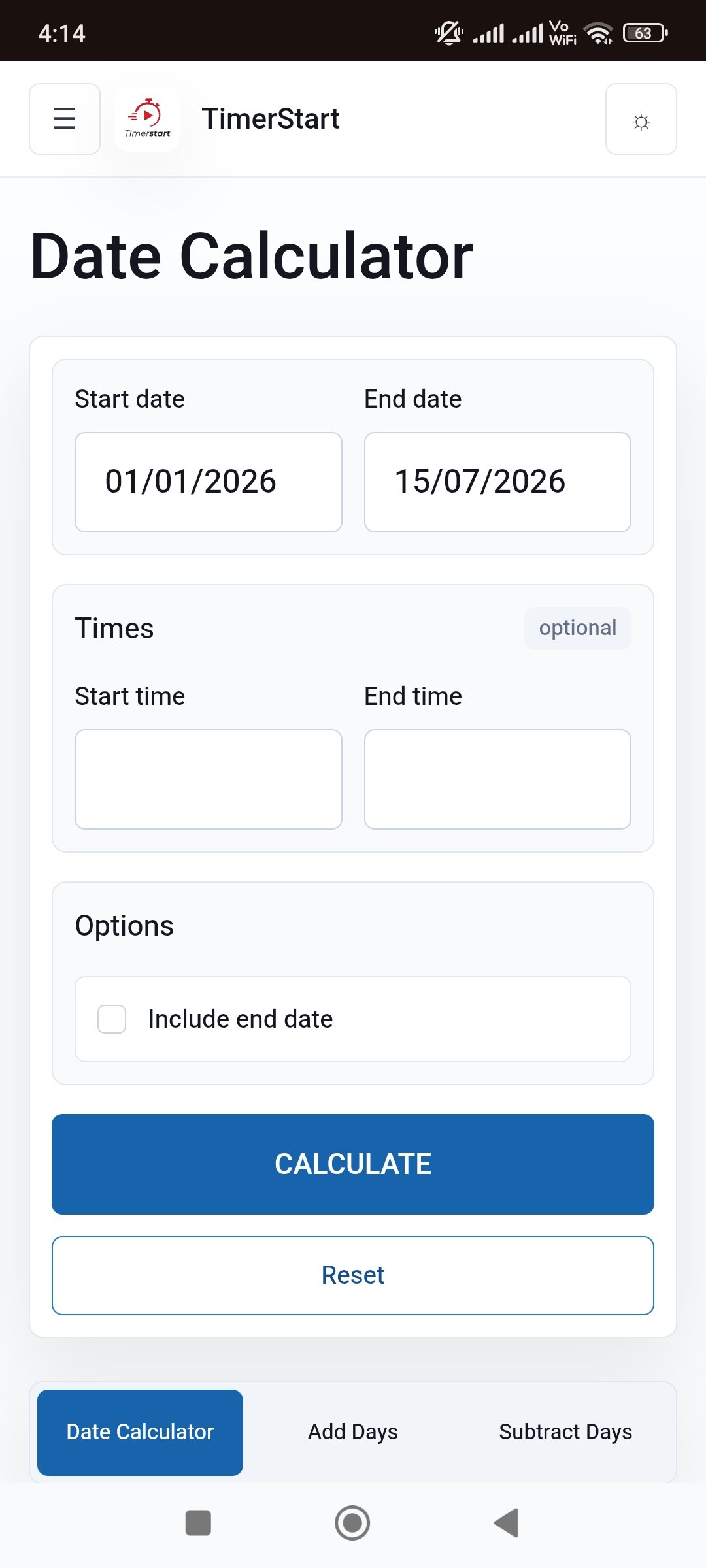
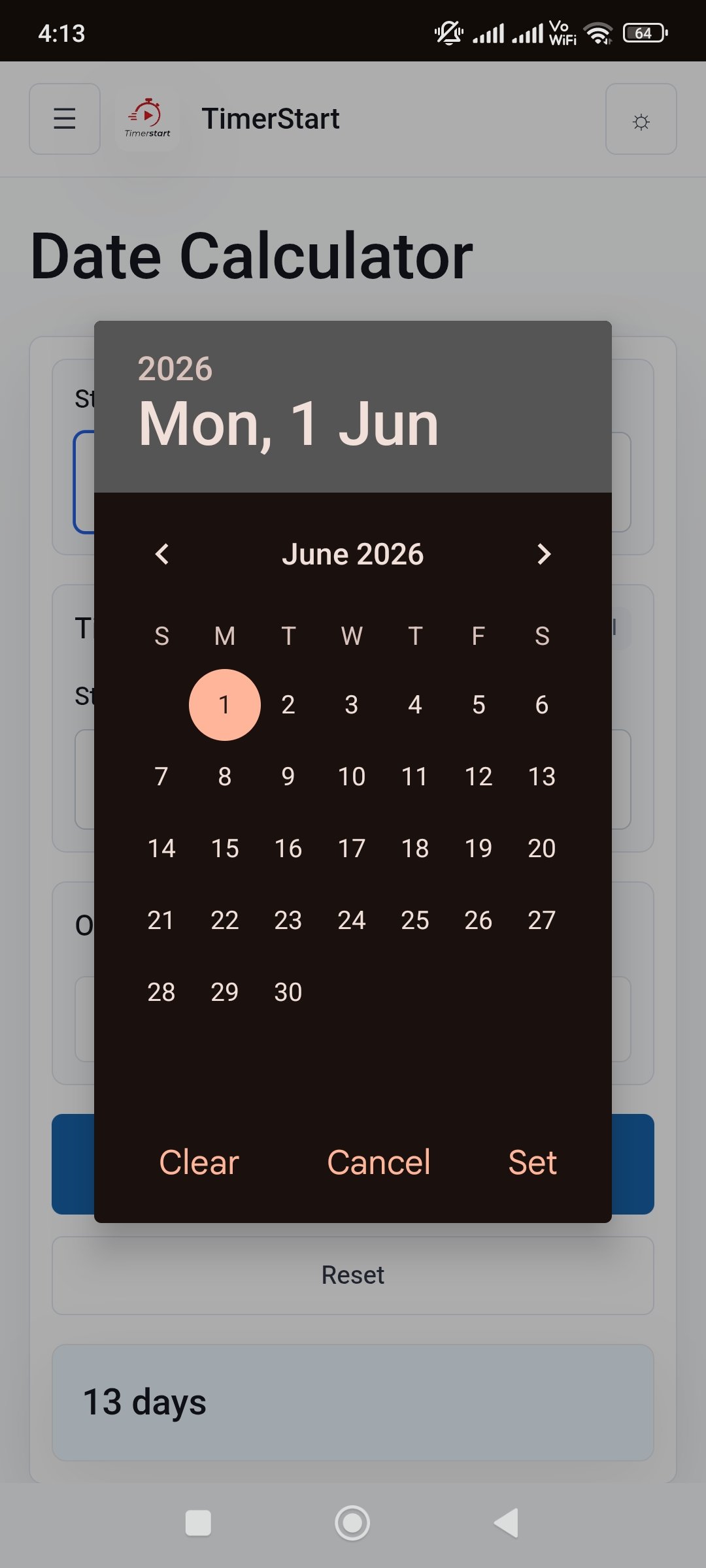
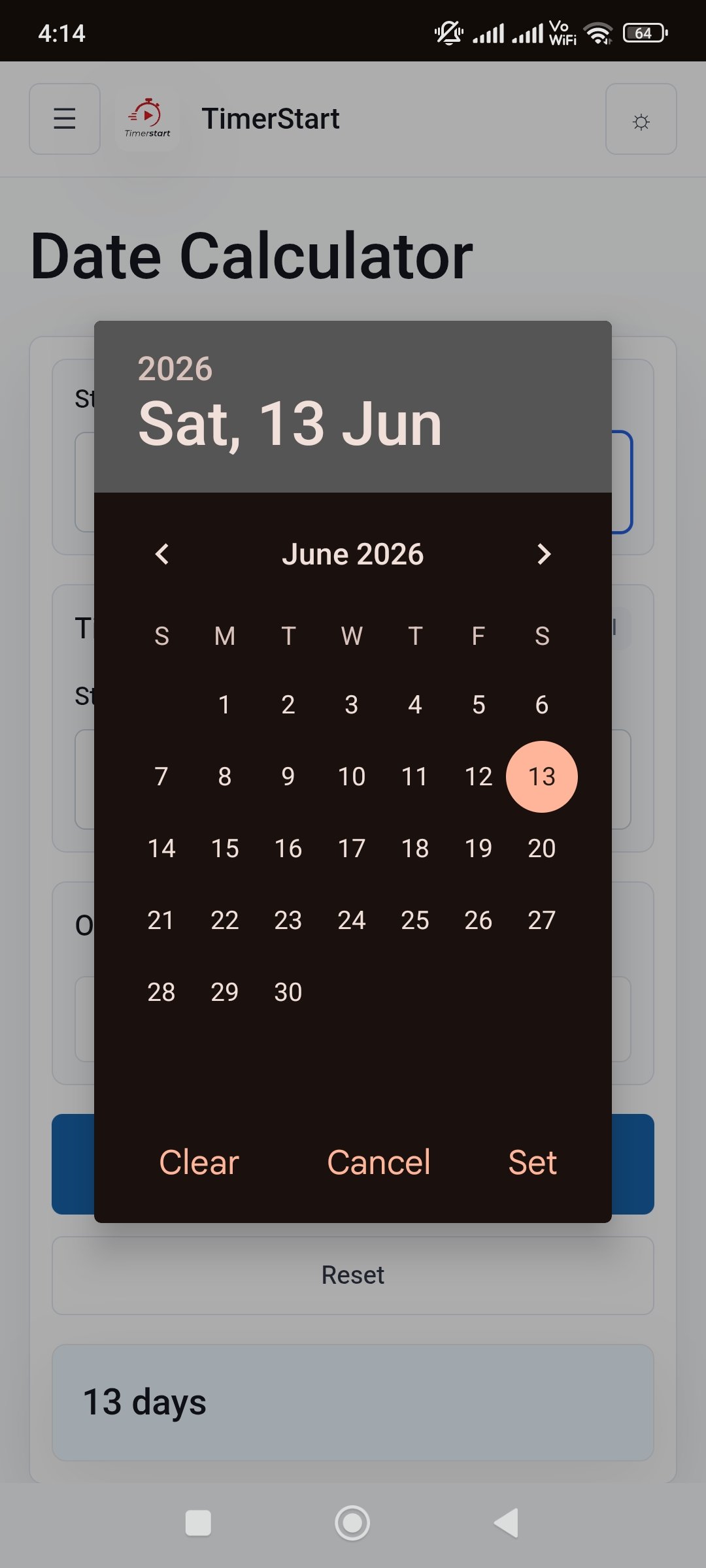
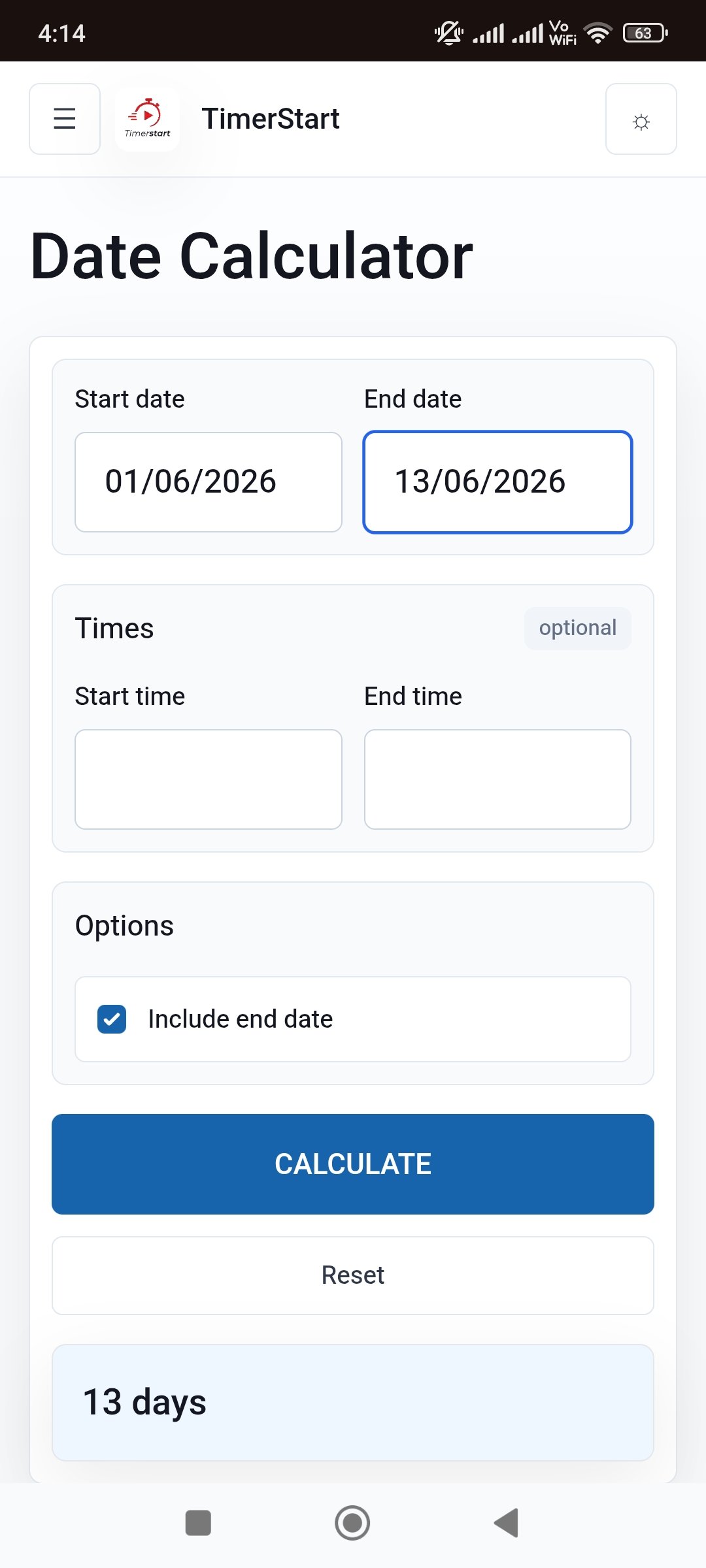
Open the Date Calculator, enter your start date, enter your end date, decide whether the end date should be included, and review the result. That's the whole process.
If your calculation uses calendar days, enter both dates in TimerStart's Date Calculator and choose whether the end date should count.
Watch a Quick Walkthrough
Date Calculator Workflow
Swipe or scroll to view the Date Calculator steps.
When TimerStart Is Not the Right Calculator
Worth being upfront about this, since it matters more than it might seem: TimerStart's current Date Calculator isn't the right tool if you need weekends automatically removed, country-specific public holidays excluded, bank holidays excluded, court-day or trading-day calculations, an organisation's specific working schedule applied, or legal interpretation of what a deadline actually requires.
In those situations, a dedicated business-day calculator or a direct check against the official rule is the better path. This isn't a small caveat - it's the difference between getting a useful number and getting a number that looks right but answers the wrong question.
Practical Calendar-Day and Business-Day Examples
A five-business-day shipping estimate that begins on a Friday would usually skip the weekend in between. A ten-calendar-day countdown to a personal event includes both Saturdays and Sundays along the way. A policy that says "seven working days" is worth double-checking for weekend and holiday exclusions before you trust the number. A date calculator comparing an arrival and departure date gives you a straightforward calendar-day gap. And a five-business-day period can stretch out further than expected if a recognised holiday happens to fall inside it.
Common Mistakes When Counting Days
The errors that come up most often: assuming "days" automatically means business days, assuming weekends are always excluded, assuming every weekday counts as a business day, ignoring public holidays entirely, mixing up day type with inclusive counting, miscounting the starting date, using a calendar-day calculator when a business-day rule actually applies, trusting a general article over the official rule that governs your situation, misreading a date format, and ignoring time-zone or cutoff details that matter for anything official.
A Simple Checklist Before You Count
Before you calculate anything, run through these checks.
Wording
- What exact words are being used?
- Does it specify calendar, business, working, or consecutive days?
Exclusions
- Do weekends count?
- Are public holidays excluded?
Counting Method
- Does the start date count?
- Does the end date count?
- Is a particular time zone or cutoff time involved?
Risk
- Is this deadline official or high-stakes?
- Does TimerStart actually support the counting method this situation requires?
Use the Right Counting Method
Use TimerStart when you need to compare calendar days between two dates. Use another method, or verify the applicable rule directly, when weekends, holidays, or a specialist day definition need to be excluded.
For other date math, you can also use TimerStart's Add Days calculator or Subtract Days calculator.
FAQs About Calendar Days and Business Days
These answers cover the common questions people ask when deciding whether weekends, holidays, start dates, or end dates should be counted.
What is the difference between calendar days and business days?
Calendar days include every date, weekends included. Business days usually mean weekdays only, with weekends excluded and holidays handled according to whatever rule applies.
Do weekends count as calendar days?
Yes - every date on the calendar counts, including Saturday and Sunday.
Do weekends count as business days?
Usually not, though this depends on the specific rule or organisation involved.
Are public holidays included in calendar days?
Yes. A holiday is still a date, so it stays included in a calendar-day count.
Are public holidays business days?
Often not, but whether a holiday is excluded - and which holidays apply - depends on the relevant country, organisation, or policy.
Is Saturday a business day?
Usually not, though some industries do treat weekends as working days.
Is Sunday a business day?
Usually not, for the same reason as Saturday.
What does five business days mean?
Generally five weekdays, skipping Saturday and Sunday - though a public holiday inside that range can extend the result.
What does ten calendar days mean?
Ten consecutive dates, weekends included, with nothing skipped.
Are working days and business days the same?
Usually treated as synonyms, though some organisations define them slightly differently.
Do I count the starting date?
That depends on inclusive versus exclusive counting, which is a separate question from calendar versus business days. Check the specific rule you're following.
Do I count the end date?
Same answer - it depends on the rule, though TimerStart lets you choose whether to include the end date in its calculation.
Does TimerStart calculate calendar days?
Yes, that's exactly what its Date Calculator compares.
Can TimerStart exclude weekends and holidays?
No, not currently. It compares calendar days and doesn't automatically remove weekends or public holidays.
Why do two date calculators show different results?
Usually because one is counting calendar days and the other business days, or because they handle the start and end dates differently. Worth checking which method each one is actually using.
Can I use a calendar calculator for an official deadline?
Treat it as a helpful starting point rather than a final answer. Legal, tax, immigration, medical, employment, banking, court, and other official periods often use their own specialised counting rules - confirm anything important with the relevant authority or a qualified professional.
Related reading
For more Date Calculator help, read calculate days between two dates, how to subtract days from a date without counting manually, 120 or 180 days from today, 30, 60, or 90 days from today, and 30, 60, or 90 days ago.